
Preble County Projected Release Dates
A projected date is a current calculation, not proof that a gate will open on that day. ODRC uses the exact public label Expected Release Date/Parole Eligibility Date. The combined label matters. It can represent an expected end point for one sentence structure or the date when a person becomes eligible for Parole Board consideration. Eligibility does not mean release was granted.
An actual release date records a completed custody event. For a Preble County Jail departure, that evidence comes from the sheriff's processed booking and release or custody-movement record. For an Ohio prison departure, the ODRC status and detail are central. A court order can authorize release, but it does not prove when jail staff completed processing. Compare the order with the custody record.
Scheduled versus actual: A future date is subject to sentence rules, credit, discipline, holds, court action, and agency processing. Only a completed release record confirms departure.
A pretrial detainee is different. Before sentence, no fixed term may exist. Bond can permit release once conditions are met, while a new warrant or detainer can keep custody in place. A detainer is a request or legal hold from another authority. It can cause transfer or continued custody even when one Preble County case would allow release.
Find a Preble County Release Date
First classify the case. A Preble County jail-only sentence does not automatically create an ODRC record. A state prison sentence does. Federal sentences use Bureau of Prisons calculations, which are separate from Ohio law. Mixing those systems is the fastest way to reach the wrong date.
- Identify the sentencing court and whether the person is in the county jail, an Ohio prison, federal custody, or another agency's custody.
- For an Ohio prisoner, open the ODRC Offender Search. Search by offender number when known, then verify the county, docket, and identifiers.
- Read the complete status and the combined Expected Release Date/Parole Eligibility Date field. Check whether it is a projected date or parole eligibility.
- For a county jail sentence, read the sentencing entry, jail-time credit, and later orders. Ask the sheriff for the processed release or movement record.
- Check for later court action, supervision status, another hold, or transfer. Confirm the actual event with the agency that held the person.
The ODRC detail may also show admission information, institution, offenses, sentencing county and docket, jail-time credit, sentence, supervision, and hearing fields. ODRC warns that sentence lists can be incomplete. A correct name match is only the start. The offender number and case details should agree before the date is used.
The official definitions explain the status and date labels used in a Preble County state-prison release-date lookup.
Read the ODRC status and release-date definitions.
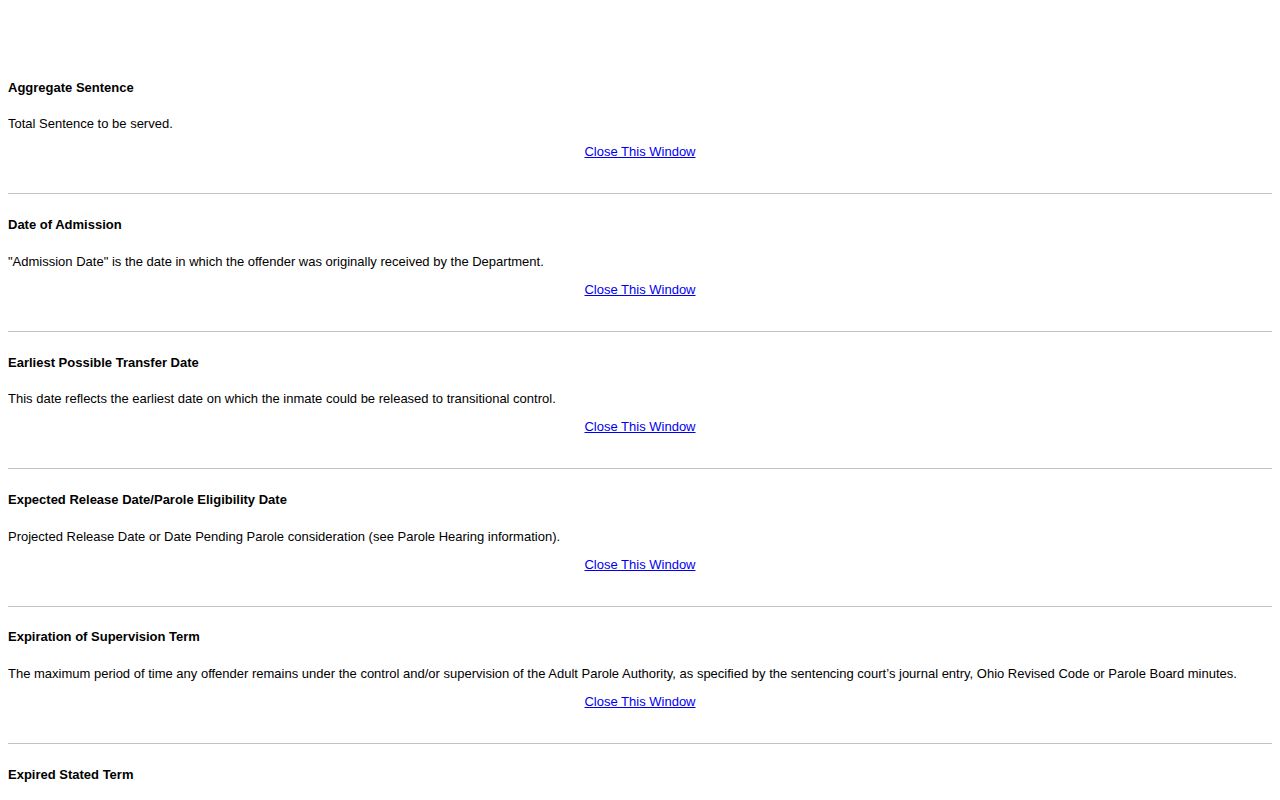
The labels distinguish projected release, parole eligibility, custody, and final supervision milestones that can otherwise be confused.
Note: ODRC county-of-commitment searches use the sentencing county and may query only the first county when several commitments exist.
ODRC Preble County Date Fields
ODRC definitions use PRD for projected release date and POA for parole on or after. The phrase Expired Stated Term concerns a term reduced by jail-time credit. An earliest possible transitional-control transfer is not a final release date. These labels describe different legal and administrative points.
| ODRC field or status | How to read it |
|---|---|
| Expected Release Date/Parole Eligibility Date | A combined field that may be a calculation or an eligibility date, depending on the sentence. |
| Incarcerated | The person remains in ODRC prison custody. |
| APA Supervision | Prison custody ended, but state parole or post-release supervision remains. |
| Released | A broad status whose qualifier must be opened and read, such as judicial release or death. |
| Next hearing month | A Parole Board review time, not a promised release date. |
| Expiration of supervision | The end of legal control, which can occur after physical release. |
A released status still needs context. One official record can state judicial release, while another can use death as the qualifier. APA Supervision means the person is out of prison but not fully discharged from state control. Reading the full detail prevents a date label from being mistaken for a current physical location.
Ohio Earned Credit for Release
A calculation begins with the sentencing entry and stated term. It then accounts for jail-time credit under ORC 2967.191, mandatory portions, consecutive or concurrent terms, indefinite-sentence rules, and statutory eligibility. Consecutive terms run one after another. Concurrent terms run at the same time. These basic structures can produce very different projected dates from sentences that sound similar in casual conversation.
Ohio Revised Code 2967.194 is the current earned-credit statute for eligible confinement on or after April 4, 2024. It provides provisional one-day or five-day monthly productive-participation categories, possible extra completion credit, conduct requirements, exclusions, and caps. Ordinary monthly and completion credits described there have a 15 percent aggregate ceiling. Separate qualifying achievement credit can be limited to 90 days or 10 percent of the stated term, whichever is less, subject to exclusions.
Earlier eligible confinement may remain under former ORC 2967.193. ODRC can deny or withdraw provisional earned credit based on conduct and statutory rules. Mandatory terms and excluded offenses can limit or prevent credit. Judicial release, transitional control, parole action, revocation, and recalculation can also change the practical date.
The captured Ohio statute shows the categories and limits that govern eligible earned credit.
View the official Ohio earned-credit statute.
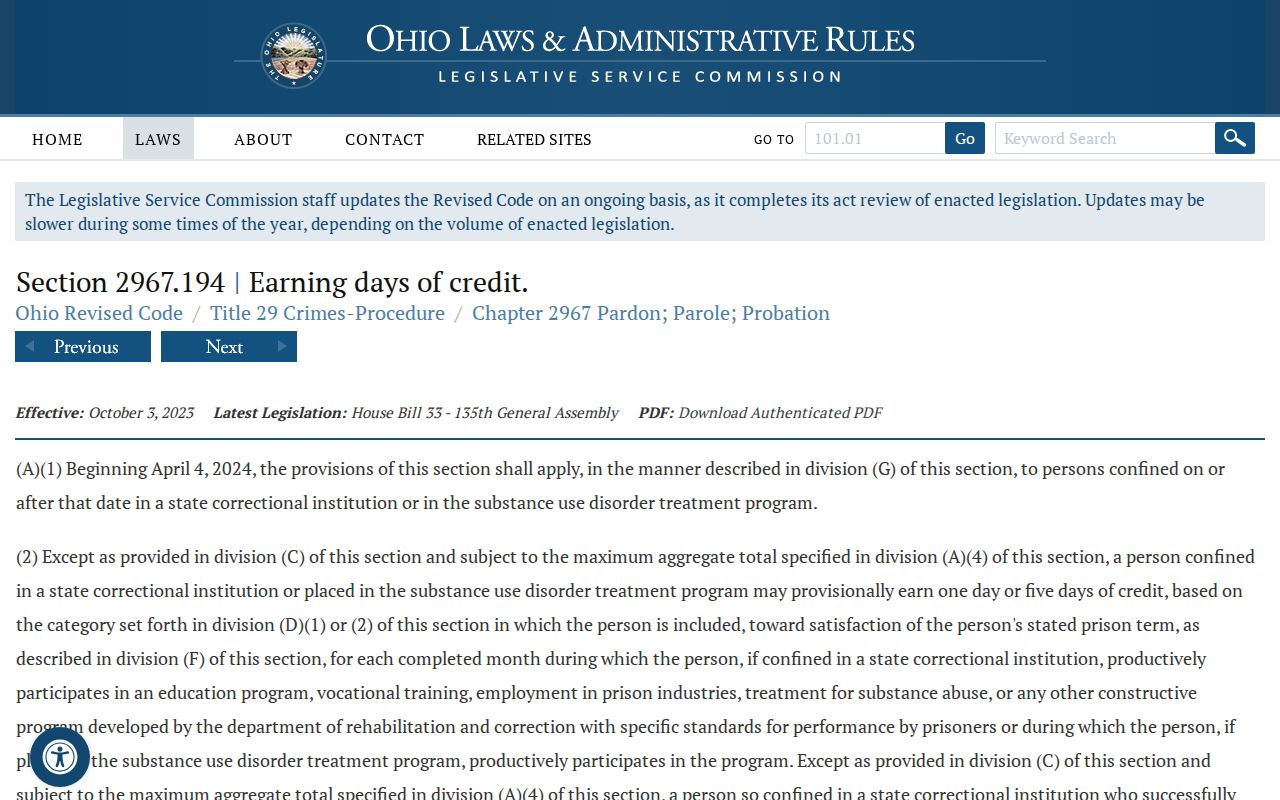
The statute must be applied to the actual sentence and eligibility facts, not reduced to a general percentage claim.
No Universal Ohio 85 Percent Rule
Ohio does not have one universal rule requiring every incarcerated person to serve exactly 85 percent. That phrase is often derived by subtracting the ordinary 15 percent earned-credit ceiling from the full term. The shortcut ignores people who are excluded, mandatory time, separate achievement credit, old-law sentences, indefinite terms, jail credit, discipline, judicial release, and Parole Board action.
Never calculate a Preble County release date from sentence length alone. The official entry and ODRC calculation control. Even an eligible person may not earn the maximum. A date can move when provisional credit is denied or withdrawn, when a court modifies the sentence, or when a new legal event changes how time is counted.
Note: The 15 percent figure is a ceiling for specified ordinary credits in eligible cases, not a guaranteed deduction for every Ohio sentence.
Why Preble County Release Dates Change
A projected date is recalculated as the controlling facts change. Some changes arise within ODRC. Others come from a court or another agency. The public detail may take time to reflect a fresh order, so the date shown on one visit should be treated as a dated observation.
| Factor | Possible effect | Where to verify |
|---|---|---|
| Jail-time credit | Reduces time remaining when the court and ODRC apply credit. | Sentencing entry and ODRC detail |
| Earned credit or credit loss | Can move an eligible projected date earlier or later within statutory rules. | ODRC calculation and governing statute |
| Detainer or warrant | Can cause continued custody or transfer after one term permits release. | Holding agency and relevant court |
| Judicial release or new order | Can change the prison term or authorize an earlier custody change. | Court journal entry and ODRC status |
| Parole decision | May grant, deny, or continue review for an eligible sentence. | Parole Board result and ODRC detail |
| Revocation or recalculation | Can restore custody or change the time remaining. | APA, court, and ODRC records |
Release and discharge are also distinct. A person may leave prison and begin APA supervision. The physical release date does not end that legal term. ODRC fields for supervision expiration or early termination address the later milestone. Court-supervised judicial release can likewise place a person in the community under continuing control.
Preble County Weekender Release Dates
Preble County publishes rules for intermittent sentenced inmates, often called weekenders. An intermittent sentence is served in separate blocks rather than one continuous jail stay. A scheduled departure after a weekend block is therefore not necessarily final release. The sentence continues through later reporting periods until the ordered intervals are complete.
The Sheriff's weekender information says that after completion, a letter goes to the appropriate probation department. That local detail matters when a person leaves the jail on schedule but still has more intervals or supervision ahead. Use the sentencing order, reporting record, and final completion documentation. Do not label each weekend departure as completion of the sentence.
Preble County has not published a county-jail good-time formula or general weekend-release statute on its local pages. ODRC prison credit rules should not be imported into a county jail sentence. Ask the jail and sentencing court about the actual order instead of supplying a generic calculation.
Preble County Jail Sentence Dates
A person serving a local jail sentence may have no ODRC Expected Release Date field because state prison custody never began. Use the court's stated term, its jail-time-credit finding, and any later modification. Then ask the sheriff for the processed departure record. The court establishes the sentence, while the jail documents physical movement.
Common Pleas CourtView and Eaton Municipal Court are separate systems. Search the court that handled the case, read the chronological docket, and open the journal entry when available. Eaton warns that online case information can lag at least a day and sometimes longer. A posted sentence or release order is still not the same as completed jail processing.
Another warrant or agency hold can change the destination even after a local term ends. The movement record should name the receiving agency on transfer. When no county formula or fixed release practice is published, a direct, date-specific request is more reliable than an estimate based on another Ohio jail.
Confirm Preble County Actual Release
For a state prisoner, compare the projected field with the current ODRC status after the expected date. For a county sentence, request the sheriff's processed departure time and authority. If the destination is another agency, call it a transfer. The local court order explains the legal basis, while the movement record shows what the jail did.
A Preble County VINE inmate check can provide a custody-change alert. It cannot guarantee the precise time or legal reason, and notification may lag. The Preble County released inmate search provides the full cross-system path when the jail, court, state, federal, or immigration source may control.
BOP projected dates follow federal rules and must remain separate from Ohio calculations. A past BOP date with Released and no location confirms exit from BOP custody only. In every system, the safest conclusion names the agency, the field, and the date checked. That makes the distinction between expected and actual release plain.